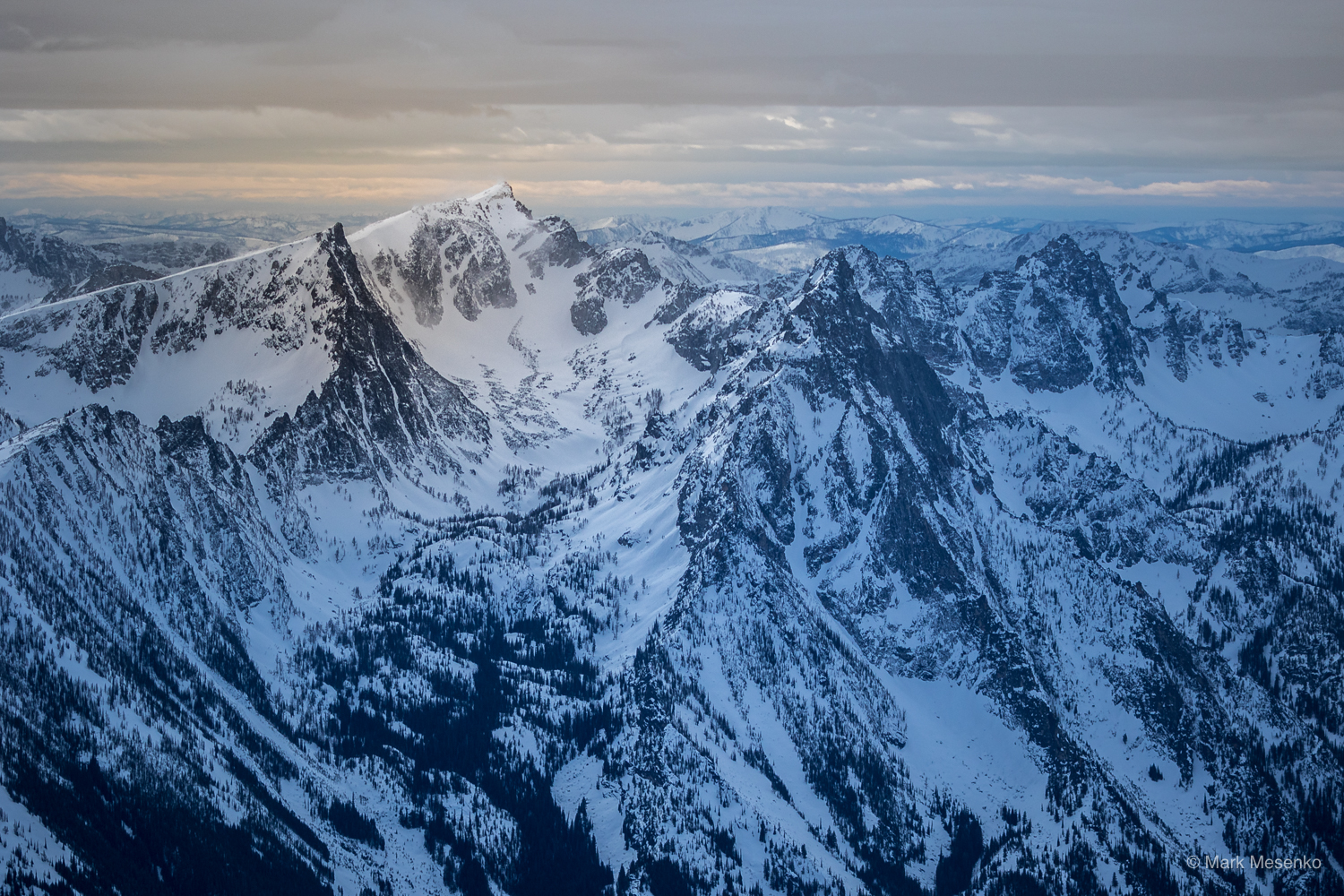
Crossing Lewis and Clark Pass
By editor
Lincoln, Lewis and Clark County, Montana
The Road to the Buffalo traced a course through Alice Creek valley and over the mountain now known as Lewis and Clark Pass long before Meriwether Lewis trod its path on July 7, 1806. This ancient corridor served as a vital artery for the Salish people and their ancestors, linking the Blackfoot Valley to the expansive buffalo plains east of the Rocky Mountain front. The trail bore the marks of countless feet and hooves, worn deep into the earth as a true road, molded by the persistent passage of generations.
Lewis approached the pass from the west, following the Blackfoot River upstream and ascending through a mosaic of open Douglas-fir (Pseudotsuga menziesii) and Engelmann spruce (Picea engelmannii) forests, interspersed with subalpine meadows flush with beargrass (Xerophyllum tenax) and huckleberry (Vaccinium membranaceum). At 6,325 feet, the summit unveils a panoramic vista of the eastern plains, a vast expanse of grassland stretching toward the Missouri River. In his journal, Lewis recorded the route as "an excellent road," noting the gentle slope descending eastward, a rarity amid the more abrupt mountain passes of the Northern Rockies.
The geology of Lewis and Clark Pass reveals a complex interplay between ancient sedimentary rocks and the tectonic forces that uplifted the Rocky Mountains. The pass slices through the Belt Supergroup, a Precambrian sequence of argillites and quartzites deposited some 1.4 billion years ago in a vast inland sea. Over eons, these layers folded and fractured, their edges ground smooth by Pleistocene glaciers that sculpted the valleys and ridges still visible today. The gentle incline Lewis noted owes much to this glacial smoothing, which fashioned the pass into a natural corridor.
Long before Lewis's arrival, the Salish people had named and traversed this route, following the trail that led to the buffalo herds essential to their subsistence and culture. From the Blackfoot Valley, they journeyed eastward, crossing the Continental Divide here to hunt bison and trade with neighboring tribes. The trail's importance resonated in the land itself-- worn into the earth like the grooves of a river, shaped by tribal movement and seasonal cycles.
Following Lewis’s passage, the region slowly attracted Euro-American settlers. The first homestead in the Alice Creek area was established in 1898, when John Patterson claimed a ranch in the valley just below the pass. His barn straddled the Road to the Buffalo, a circumstance that brought settlers into direct contact with the Native travelers who still followed the ancient trail. Patterson’s family often observed Salish and other Indigenous people passing through, their presence a living continuation of the trail’s original purpose.
Life on the range in this part of Montana around 1900 was marked by hardship. The early snows and long winters drastically shortened the summer work season. Alberta Patterson’s mother recalled placing the toddler Alberta into a wooden apple box used as a portable crib, carrying her along as fences were built and land tended. Such anecdotes reflect the intimate relationship between people and place, the demands imposed by this rugged environment.
In the 1840s, Father Nicholas Point, a Jesuit missionary, retraced this route, becoming the first Euro-American to pass this way since Lewis. Traveling with Salish hunting parties, Point documented one bison-hunting expedition where they reached "the summit of mountain from which one could see a horizon more than a hundred leagues in circumference." His words capture the vastness revealed from Lewis and Clark Pass, a vantage point revealing the extent of the western plains.
Military interests soon followed. Isaac Stevens, governor of Washington Territory, dispatched expeditions in the 1850s to survey routes for military roads and a transcontinental railroad. These parties explored the Blackfoot Valley and Alice Creek, considering Lewis and Clark Pass as a potential corridor. Stevens favored this route for railroads and roads, believing it superior to alternatives. He remarked that the pass offered the "easiest crossing of the Continental Divide in these latitudes." Despite his preference, the railroad was ultimately laid over Mullan Pass, some 25 miles south, a decision influenced by gradients, timber availability, and connections to existing routes.
The Forest Service established the Alice Creek Guard Station near the pass in the early 20th century to manage the surrounding Helena National Forest. From this station, rangers conducted winter game surveys and summer patrols for range riders and fire guards. Today, only the foundation remains, a faint trace of the forest stewardship that shaped land use here.
The flora around the pass is a textbook study of subalpine ecology. Lodgepole pine (Pinus contorta) dominates the lower slopes, giving way to Engelmann spruce and subalpine fir (Abies lasiocarpa) at higher elevations. Wildflowers such as the glacier lily (Erythronium grandiflorum) bloom in spring meadows, heralding the short growing season. Fauna includes mountain goats (Oreamnos americanus), mule deer (Odocoileus hemionus), and the occasional grizzly bear (Ursus arctos horribilis), whose territories overlap this corridor.
The pass remains a corridor not only of human history but of natural processes, shaped over a billion years by sedimentation, uplift, and glaciation. It is a place where the ancient and recent past converge--where the footsteps of native hunters, explorers, settlers, and rangers have followed the land’s contours and the call of the open plains beyond.
See also
- Crossing Lewis and Clark Pass at Lincoln, Lewis and Clark County
- Lewis and Clark Pass at Lincoln, Lewis and Clark County
- Road to the Buffalo at Lincoln, Lewis and Clark County
Where to Stay in Montana
Affiliate links help support this site at no extra cost to you