History
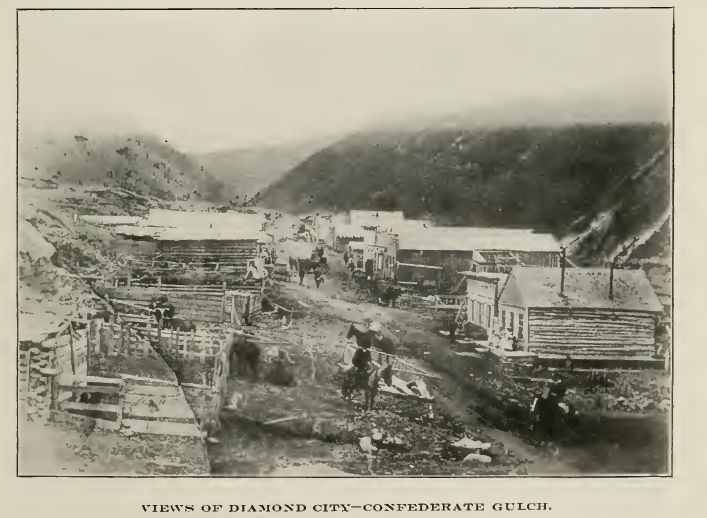
Diamond City Cemetery is an inactive burial ground located in Broadwater County, Montana, serving the historic gold mining boomtown of Diamond City and the surrounding Confederate Gulch. The town of Diamond City was founded on December 3, 1864, following the discovery of gold by four ex-Confederate soldiers. The area experienced a significant boom with the discovery of the "Montana Bar" in late 1865, which was one of the richest placer gold strikes per acre ever made. Diamond City quickly grew, reaching a peak population of approximately 5,000 residents by 1867. During its heyday, it served as the county seat for Meagher County, which later became part of Broadwater County. The intense hydraulic mining operations employed to extract gold eventually consumed the original townsite, forcing Diamond City to relocate.
By 1870, the gold reserves in Confederate Gulch were largely exhausted, leading to a rapid decline in Diamond City's population. By 1870, only 255 residents remained, and a year later, the population further dwindled to about 60. The county records were officially moved from Diamond City to White Sulphur Springs in March 1881, marking the end of its prominence. The post office, established in 1867, operated until December 1908, with a brief reopening in 1909.
Today, very little remains of the original Diamond City townsite due to the destructive nature of hydraulic mining. The cemetery, however, persists as one of the few tangible remnants of the era. It is known by several names, including Graveyard Bar Cemetery, Boulder Bar Cemetery, and Confederate Gulch Cemetery. The cemetery is situated in a remote location on private property, approximately 3.1 miles up Confederate Gulch in the Big Belt Mountains. It is not publicly accessible and is not visible from the main road, being located about 500 yards to the right of the road on a steep cliff. The site is enclosed by a fence, and records suggest around 65 individuals are buried there. Efforts were made to restore the cemetery, and some original wooden tombstones, like that of Mrs. Spiegel, are preserved in the Broadwater County Museum.
Landscape and markers
The cemetery is a physical record of the harshness of the frontier. The dates carved into the markers tell a story of brief booms and sudden collapses, of winters that took the young and mining accidents that took the strong. To walk among these graves is to feel the immense weight of the past pressing down on the present landscape.
Who is buried here
The stones here tell the story of the settlement. Olive M. Barnes (1838-1877/06/03): Wife of H.H. Barnes, died shortly after arriving in Diamond City from California and Maine. Her death was chronicled in the Rocky Mountain Husbandman. Emily Buckingham (1851-1892): Born in England, first wife of Abraham John Buckingham, mother of seven children born in Montana. John Buckingham (1827-1899/06/25): Born in England, miner, listed in the 1870 and 1880 census records for Diamond and Confederate Gulch. John Christie (1897/03/30-1898/03/21): Son of George and Victorine (Ogier) Christie, died as an infant. His stone was moved to Fairview Cemetery, but his body remained. Minnie Christie (1894/12/12-1899/05/24): Daughter of George and Victorine (Ogier) Christie, died as a young child. Mrs. Spiegel: Her original wooden tombstone is housed in the Broadwater County Museum. Her grave was tended by Al Yerdun until his death in the 1920s.
Visiting
Diamond City Cemetery is located in Broadwater County, Montana, approximately 3.1 miles up Confederate Gulch in the Big Belt Mountains. It is situated in Township 10 North, Range 2 East, Section 25. The cemetery is on private property and is not accessible to the public. It is not visible from the road, as it lies about 500 yards to the right of the road on top of a steep cliff. The site is enclosed by a fence. Visitors should be aware that the road conditions are unimproved dirt roads, and access is restricted due to private land ownership. There are no specified hours of operation, and visitors should not attempt to access the site without permission from the landowner. The nearest town is Townsend, Montana. When arriving, expect to find an inactive cemetery with potentially around 65 burials, some with scattered wooden markers, and others with more substantial headstones, all within a fenced area on a steep hillside.