History
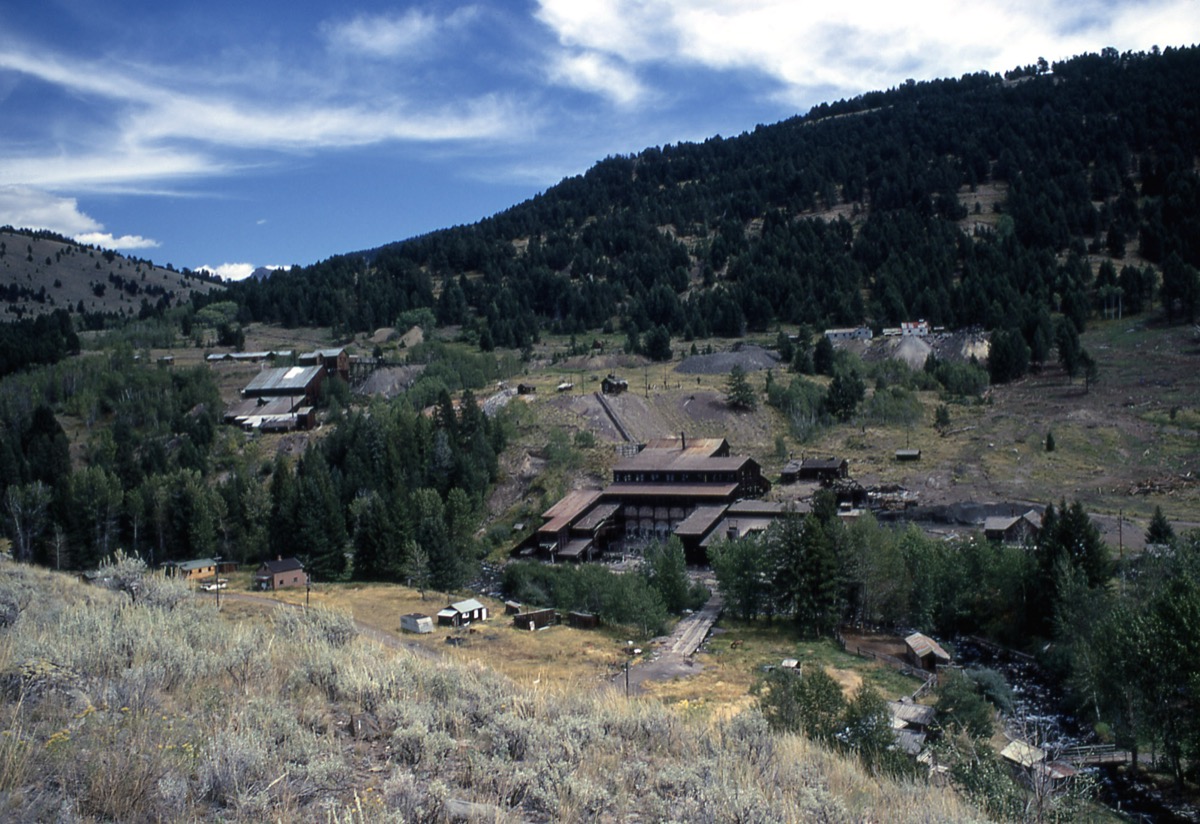
Jardine, Montana, an unincorporated village in Park County, is situated just north of Gardiner, adjacent to Yellowstone National Park. The town's genesis was intrinsically linked to the gold mining industry. Gold was initially discovered in Bear Gulch in 1866, but it wasn't until 1898 that significant mining operations commenced with Harry Bush's acquisition of claims and the establishment of a settlement, initially named Bush. This burgeoning camp rapidly expanded to approximately 130 buildings, attracting a considerable number of miners. However, Bush's enterprise faced financial difficulties, leading to its receivership in 1901.
The camp underwent a renaming in 1902, adopting the moniker Jardine, in honor of A. C. Jardine, a prominent businessman within the mining sector. In 1903, the Kimberly-Montana Gold Mining & Milling Company assumed control, implementing substantial upgrades including the construction of a 150-ton cyanide plant and additional stamp mills. Despite these considerable investments, the company ultimately failed in 1906. Subsequently, in 1918, the Jardine Gold Mining & Milling Company acquired the properties, continuing the extraction of gold and scheelite ores until 1921. The Jardine Mining Company then took ownership, leading to the discovery of arsenic and the operation of an arsenic plant from 1923 to 1945. The mill continued to process various ores until a fire in 1948 destroyed the cyanide plant, marking the closure of the mill and a significant decline for the town.
The Jardine Cemetery, located approximately half a mile north of Jardine, Montana, saw its first burials as early as 1894, indicating its establishment alongside the nascent mining community. Its design features a tree-lined road, suggesting a degree of planning and care in its early development. The cemetery primarily served the residents of Jardine and the surrounding mining population, reflecting the transient and often challenging life in a boom-and-bust mining town. While specific historical events directly impacting the cemetery's founding beyond the general mining boom are not extensively documented, its existence is a direct consequence of the community's growth and the inevitable human cost associated with such endeavors.
Today, the Jardine Cemetery remains an active site, with records indicating about 55 memorials, a significant portion of which are photographed and have GPS coordinates. This suggests ongoing community interest and efforts in its preservation and documentation. Although a detailed current condition report is not readily available, the continued presence of memorials and photographic documentation implies that the cemetery is maintained to some extent, serving as a tangible link to the rich mining history of Jardine and Park County.
Landscape and markers
The cemetery is a physical record of the harshness of the frontier. The dates carved into the markers tell a story of brief booms and sudden collapses, of winters that took the young and mining accidents that took the strong. To walk among these graves is to feel the immense weight of the past pressing down on the present landscape.
Who is buried here
The stones here tell the story of the settlement. Viola Athas (Dec. 7, 1928 - Nov. 19, 2000) Kimberly Kay Crabb (1974 - 1990) Charles S. Cunningham (1907 - 1960) Mollie H. Downs (1874 - 1908) Jim Duffy (1948 - 1984) Amy Louise Gallaher (Jul. 20, 1973 - Apr. 7, 2001) - wife of James Gallaher Ashley Nicole Gallaher (Dec. 22, 1989 - Apr. 7, 2001) - daughter of James & Amy Gallaher James A. "Sonny" Gallaher (Aug. 17, 1935 - Jun. 28, 1999) James Gondie (1876 - Jul. 11, 1902) Alice May Guest (May 21, 1898 - May 22, 1902) - daughter of John P. & Ida May Guest Ida May Guest (Apr. 8, 1868 - Sep. 8, 1902) - wife of John Phillip Guest Del H. Hansen (Jul. 22, 1939 - Aug. 26, 1962) - son of Orb H. & Valera Hansen Orb H. Hansen (May 27, 1917 - May 23, 1972) - husband of Valera Troxel Hansen; son of Christian H. & Ingeborg Hansen Valera Bernadine Troxel Hansen (Apr. 11, 1919 - Aug. 4, 2011) - wife of Orb H. Hansen Minnie Harry (1871 - Aug. 1, 1902) M. M. Herman (Jan. 27, 1860 - May 8, 1906) Clarence Douglas Johnson (Dec. 3, 1955 - Oct. 19, 2010) - son of Vern & Kathryn Johnson Earl Alson Johnson (Sep. 17, 1922 - Nov. 30, 2006) William Raymond Johnson (Sep. 8, 1925 - Jul. 6, 1985) Stella May Jones (1900 - Aug. 5, 1902) - daughter of C.B. & J.A. Jones Edwin H. Judkins (1842 - Dec. 11, 1902) L. A. "Bud" Lindstrom (Jan. 25, 1922 - Jul. 1, 1995) Monte Lee Lindstrom (Jul. 16, 1947 - Jul. 10, 1964) Violet M "Mimi" Pierce Lindstrom (Sep. 17, 1907 - Sep. 7, 1995) - wife of L. A. Lindstom Nora F. Broyles Marchington (Nov. 24, 1924 - Feb. 1, 1992) - wife of Roy B. Marchington Roy B. Marchington (Apr. 10, 1923 - Sep. 26, 2003) - husband of Nora Broyles Marchington John McCann (1849 - 1931) J. D. McLennan (1849 - 1931) Doris Ostrenga (1932 - 1974) Edward H. Rife (1900 - 1902) Fred C. Rife (1904 - 1910) Robert R. Rife (1908 - 1908) Wayne E. Skertich (Jul. 13, 1946 - Apr. 9, 2005) Cecilia Smith (1853 - 1939) - wife of James Smith James Smith (Nov. 26, 1846 - Nov. 1, 1903) - husband of Cecilia Smith James Ernest Smith (Mar. 8, 1875 - Oct. 18, 1906) - son of James & Cecilia Smith David Michael Sperano (Apr. 9, 1966 - Aug. 16, 1982) Caroline Olsdatter Helle Thompson (Jul. 16, 1875 - May 30, 1923) - wife of John Lauritz Thompson; daughter of Ole J. & Marit Helle George W. Welcome (Jun. 17, 1853 - Sep. 10, 1905) Esther L. Winn (Jan. 31, 1861 - Oct. 17, 1924) - wife of I. S. Winn Jacob Adam Yarendt (Dec. 14, 1902 - Dec. 14, 1902) - son of P. & C. Yarendt Maggie Yerala (Jul. 13, 1853 - May 14, 1899)
Visiting
The Jardine Cemetery is located approximately half a mile north of the former mining town of Jardine, Montana, situated high above the town on what is locally known as Tinker Hill. It is nestled within a wooded area. Access to Jardine itself is via a gravel road off Highway 89, northeast of Gardiner, Montana, specifically Forest Road 493. Visitors should anticipate unpaved or gravel road conditions leading to the cemetery. There are no specified hours of operation, suggesting it is accessible during daylight hours. Given its remote location and association with a ghost town, visitors should expect a rustic setting, likely with varying conditions of gravestones and minimal formal signage or fencing. The presence of numerous memorials and photographic documentation suggests it is regularly visited and maintained to some degree by individuals or local groups.